
Atlanta Bankruptcy Records
Atlanta bankruptcy records are kept by the Northern District of Georgia Bankruptcy Court, which sits in the Richard B. Russell Federal Building downtown. With more than half a million people, Atlanta is the largest city in Georgia and the hub for federal court activity across the northern part of the state. You can search Atlanta bankruptcy records online through PACER, call McVCIS for free case details, or visit the clerk's office in person. The court serves Fulton County and 45 other counties, so a large share of all Georgia bankruptcy cases pass through this Atlanta office.
Atlanta Quick Facts
Federal Bankruptcy Court for Atlanta
The Northern District of Georgia Bankruptcy Court is the federal court that handles all bankruptcy filings for Atlanta residents. Its main office sits in the Richard B. Russell Federal Building at 75 Ted Turner Drive SW, Room 1340, Atlanta, GA 30303. The phone number is (404) 215-1000. Office hours run Monday through Friday, 8:30 AM to 5:00 PM. Chief Judge Barbara Ellis-Monro leads this court. Vania S. Allen serves as clerk of court and manages the day-to-day work of the clerk's office.
Atlanta is the seat of the Northern District. This makes it the main hub for bankruptcy records covering 46 counties in north Georgia, from the metro area up to the mountains. The court has divisional offices in Gainesville, Newnan, and Rome as well. But the Atlanta office handles the bulk of case filings. If you live in Atlanta or Fulton County, this is where your bankruptcy case would be filed and where the records are stored.
City courts in Atlanta do not handle bankruptcy. The Atlanta Municipal Court deals with traffic tickets and local code violations. Bankruptcy is a federal matter, so only the federal court has those records.
Searching Atlanta Bankruptcy Records
PACER is the best way to search Atlanta bankruptcy records from home. It stands for Public Access to Court Electronic Records. You need to set up a free account first. After that, you can look up any case by name or case number. PACER works around the clock. The system costs $0.10 per page to view or download court documents. You can pull up docket sheets, filed motions, schedules, and discharge orders for any Atlanta bankruptcy case in the Northern District.
The PACER Case Locator helps when you are not sure which court holds the case. It searches across all federal districts at once. Type in a name, and it will tell you which court and district has the case. This is useful for finding Atlanta bankruptcy records if the filer may have lived in a different county when they filed.
For free case information, call McVCIS at 1-866-222-8029. This is a toll-free phone system that runs day and night. It gives you the debtor name, case number, filing date, chapter type, judge, and case status. You won't get full documents, but you will get the basic details you need to start a deeper search. Select the Northern District when prompted for Atlanta cases.
Atlanta Bankruptcy Record Fees
Costs for Atlanta bankruptcy records depend on how you get them. PACER charges $0.10 per page for online access. If you walk into the clerk's office at the Russell Federal Building, you can view records on the public computer terminals for free. Printing from those terminals costs $0.10 per page.
Copies you request in person or by mail cost more. The fee is $0.50 per page. If you need a certified copy, add $12 per document on top of the per-page charge. There is also a $34 search fee if you do not have the case number and need the clerk's office to find it for you. You can use Form B1320 to submit a formal search request.
Payment at the Atlanta clerk's office can be by money order or certified check made out to "Clerk, U.S. Bankruptcy Court." Cash works for in-person visits. Personal checks are only accepted from pro se filers.
Note: PACER fees are capped at $3.00 per document for most items, so short filings often cost less than a dollar to view.
Bankruptcy Exemptions in Atlanta
Georgia has opted out of the federal bankruptcy exemptions. Atlanta filers must use state exemptions under O.C.G.A. § 44-13-100. This matters because the exemptions decide what property you can keep when filing for bankruptcy in Atlanta. The rules are the same across the state, but Atlanta's higher cost of living means these limits hit harder for many local filers.
The homestead exemption allows up to $21,500 in equity for a primary residence. Married couples filing jointly can protect up to $43,000 if the home is in one spouse's name. A motor vehicle is exempt up to $5,000. Personal property is covered up to $5,000 total, but each item must be worth $300 or less. Jewelry has a $500 limit. Tools of the trade are exempt up to $1,500. There is also a wildcard exemption of $1,200, plus up to $10,000 of any unused homestead exemption, which gives some added room.
Certain income sources are fully exempt in Atlanta bankruptcy cases with no dollar cap. Social Security, veterans benefits, unemployment pay, workers' compensation, alimony, child support, and crime victim funds all fall in this group. Most retirement accounts, including 401(k) plans, 403(b) accounts, IRAs, and pensions, are also fully protected.
Types of Bankruptcy Filed in Atlanta
Atlanta residents can file under several chapters of the federal bankruptcy code. Chapter 7 is the most common. It is a liquidation case where non-exempt assets are sold to pay creditors. Most Chapter 7 cases in Atlanta are "no asset" cases, meaning the filer keeps everything because it falls within the Georgia exemptions. Chapter 7 cases typically wrap up in three to four months.
Chapter 13 is the other main type filed in Atlanta. It sets up a repayment plan that lasts three to five years. Filers with steady income use this to catch up on mortgage payments or car loans while keeping their property. Chapter 11 is used by businesses and some high-income individuals for reorganization. Chapter 12 is rare in Atlanta since it applies only to family farmers and fishermen.
Atlanta Bankruptcy Filing Rules
You must have lived in Georgia for at least 730 days before filing to use the state's exemptions. That is two full years. If you moved to Atlanta recently from another state, you may have to use your former state's exemptions, or you might need to wait until you hit the residency mark. This is a federal rule, not a state one, and it applies to all Atlanta filers.
There are also limits on how often you can file. If you had a Chapter 7 discharge, you must wait eight years before filing another Chapter 7. The gap is four years between a Chapter 7 and a Chapter 13. Between two Chapter 13 cases, the wait is two years. These time frames run from the filing date of the earlier case, not the discharge date.
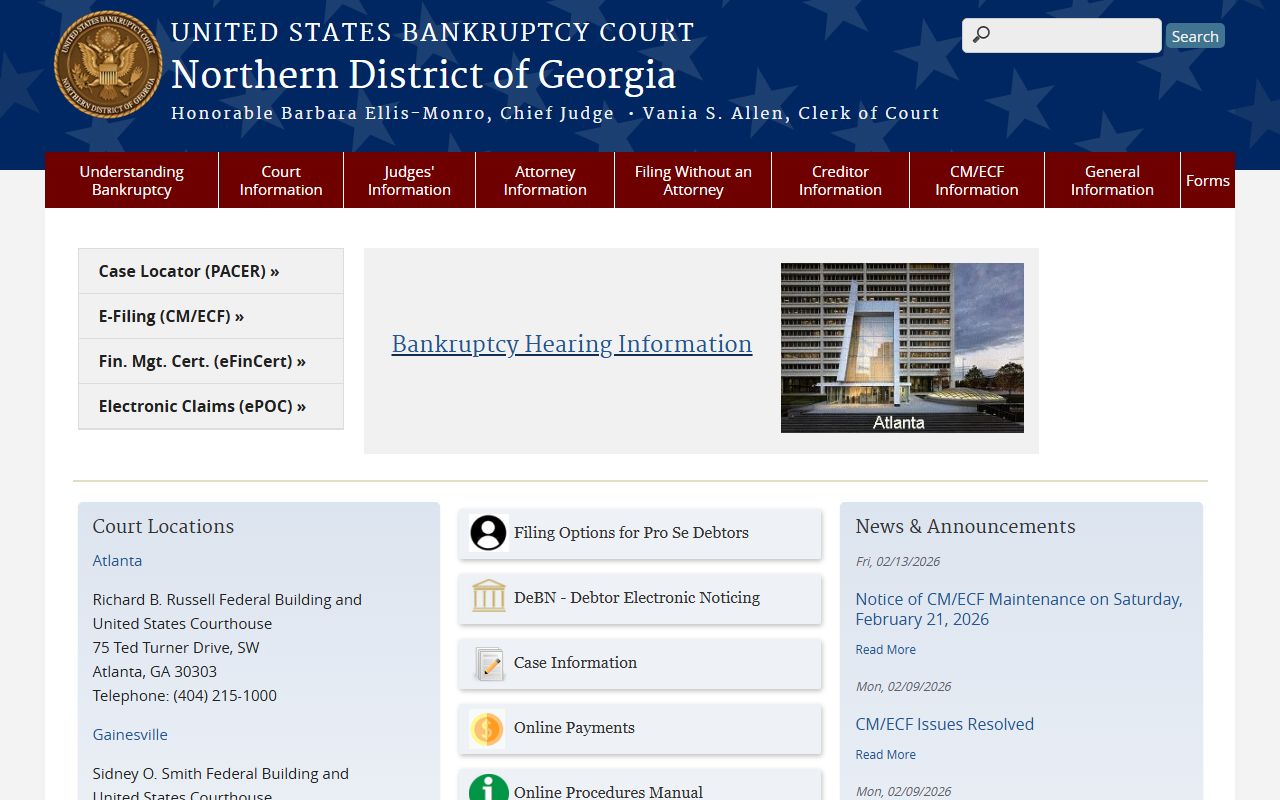
The Northern District website has filing guides and local rules that apply to Atlanta bankruptcy cases.
Archived Atlanta Bankruptcy Records
Older Atlanta bankruptcy cases are sent to the National Archives and Records Administration for long-term storage. If you search PACER and the case does not appear, it may have been archived. Contact the Northern District clerk's office at (404) 215-1000 and ask for the case number, accession number, location number, and box number. You will need all four to order copies from NARA.
The clerk's office can look this up for you. Once you have the details, go to the NARA website and submit a records request. Processing times vary, but expect a few weeks for archived records to arrive. The NARA charges its own fees for copies, separate from the court's fee schedule.
County Clerk Records in Atlanta
The Fulton County Superior Court Clerk handles state-level records that may relate to a bankruptcy case. This includes liens, deeds, and civil judgments. When a bankruptcy is filed in Atlanta, it triggers an automatic stay that shows up on related county records. The Georgia Superior Court Clerks' Cooperative Authority (GSCCCA) provides a statewide search tool for these state court records. You can use it to find liens, real estate filings, and other documents tied to a debtor.
County records do not replace federal bankruptcy records. But they can give you a fuller picture. A deed search might show a property transfer during a bankruptcy, or a lien filing might show a creditor's claim. These records are separate systems, so search both if you need a complete view of an Atlanta case.
Note: The GSCCCA database covers all 159 Georgia counties and is free to search for basic index information.
Fulton County Bankruptcy Records
Atlanta sits in Fulton County, and all bankruptcy filings for Fulton County residents go through the Northern District of Georgia Bankruptcy Court in Atlanta. The county clerk does not handle bankruptcy cases. However, the Fulton County Superior Court Clerk maintains state records that may be connected to a bankruptcy filing, such as liens and property records. For full details on county-level resources, see the Fulton County page.
Nearby Georgia Cities
Other major Georgia cities also have bankruptcy records held in federal courts. Several cities near Atlanta are served by the same Northern District court, while others fall under the Middle or Southern District.